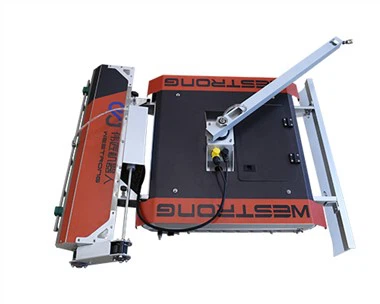
Hey there! As a supplier of photovoltaic cleaning robots, I often get asked, "Can a photovoltaic cleaning robot work in harsh weather conditions?" Well, let's dive right into this topic and explore the ins and outs of how these nifty machines handle the rough stuff.
First off, let's talk about what we mean by harsh weather conditions. We're talking about extreme heat, freezing cold, heavy rain, strong winds, and even sandstorms. These conditions can really take a toll on any equipment, and photovoltaic cleaning robots are no exception. But the good news is, modern technology has come a long way, and many of our robots are built to withstand a fair amount of abuse.
Let's start with extreme heat. In desert regions or areas with scorching summers, the temperature can soar well above 40 degrees Celsius (104 degrees Fahrenheit). This kind of heat can cause electronic components to overheat and mechanical parts to expand and contract, which can lead to malfunctions. However, our robots are designed with high - quality materials that have a high heat tolerance. They also feature advanced cooling systems to keep the internal temperature in check. For example, our BQ - 1000 Water Pipe Solar Panel Cleaning Robot is equipped with heat - resistant circuits and a built - in fan that helps dissipate heat, ensuring it can operate smoothly even in blistering heat.


Now, what about freezing cold? In winter, especially in high - altitude or northern regions, the temperature can drop well below freezing. Cold weather can make the robot's batteries less efficient, and it can also cause the lubricants in the moving parts to thicken, affecting the robot's mobility. But our robots are up for the challenge. They have insulated battery compartments to keep the batteries warm and are filled with special low - temperature lubricants. Our BQ - 700 Water Pipe Solar Panel Cleaning Robot has a battery heating system that kicks in when the temperature drops, ensuring the battery maintains its performance.
Heavy rain can also be a problem. Water can seep into the robot's electronic components, causing short - circuits and corrosion. That's why our robots are designed with a high level of water resistance. They have sealed enclosures and waterproof connectors to prevent water from getting inside. The cleaning brushes and other parts are also made of materials that won't be damaged by prolonged exposure to water. For instance, the BQ - 600 Water Pipe Solar Panel Cleaning Robot has an IPX5 waterproof rating, which means it can withstand water jets from any direction without being damaged.
Strong winds are another challenge. High - speed winds can knock the robot off the solar panels or disrupt its cleaning path. To counter this, our robots are equipped with strong suction cups or magnetic tracks that keep them firmly attached to the panels. They also have a low - profile design that reduces wind resistance. The software in our robots can also adjust the cleaning speed and pressure based on the wind conditions to ensure a stable operation.
Sandstorms are perhaps the most brutal of all harsh weather conditions. Fine sand particles can get into the robot's moving parts, causing abrasion and wear, and can also clog the filters. Our robots are built with dust - proof enclosures and high - efficiency air filters. They can also be scheduled to clean the solar panels before a sandstorm hits, reducing the amount of dust that accumulates on the panels.
Of course, even with all these features, there are limits to what a photovoltaic cleaning robot can handle. In the case of extremely severe weather such as a category 5 hurricane or a major sandstorm of epic proportions, it might be necessary to take the robot offline for its own protection. But in most normal harsh weather scenarios, our robots can continue to do their job effectively.
Using a photovoltaic cleaning robot in harsh weather conditions also brings some benefits. For example, in hot weather, cleaning the solar panels can improve their efficiency because dirt and dust can reduce the amount of sunlight the panels absorb. In cold weather, keeping the panels clean can prevent the formation of ice and snow, which can also block sunlight.
So, to answer the question, yes, a photovoltaic cleaning robot can work in harsh weather conditions. Our robots are engineered to be tough, reliable, and efficient, even when the going gets rough. Whether it's high heat, freezing cold, heavy rain, strong winds, or sandstorms, our products are designed to keep your solar panels clean and operating at their best.
If you're in the market for a photovoltaic cleaning robot that can handle harsh weather, we've got you covered. Our range of products, including the BQ - 1000 Water Pipe Solar Panel Cleaning Robot, BQ - 700 Water Pipe Solar Panel Cleaning Robot, and BQ - 600 Water Pipe Solar Panel Cleaning Robot, are ready to tackle the toughest conditions. Contact us today to discuss your specific needs and explore how our robots can help you maintain the efficiency of your solar panels.
References
- "Solar Panel Cleaning Technology: Advancements and Challenges" - Science Journal of Renewable Energy
- "Operating Equipment in Extreme Weather Conditions" - Industrial Machinery Magazine
- "The Impact of Weather on Solar Panel Performance" - Energy Research Institute Report